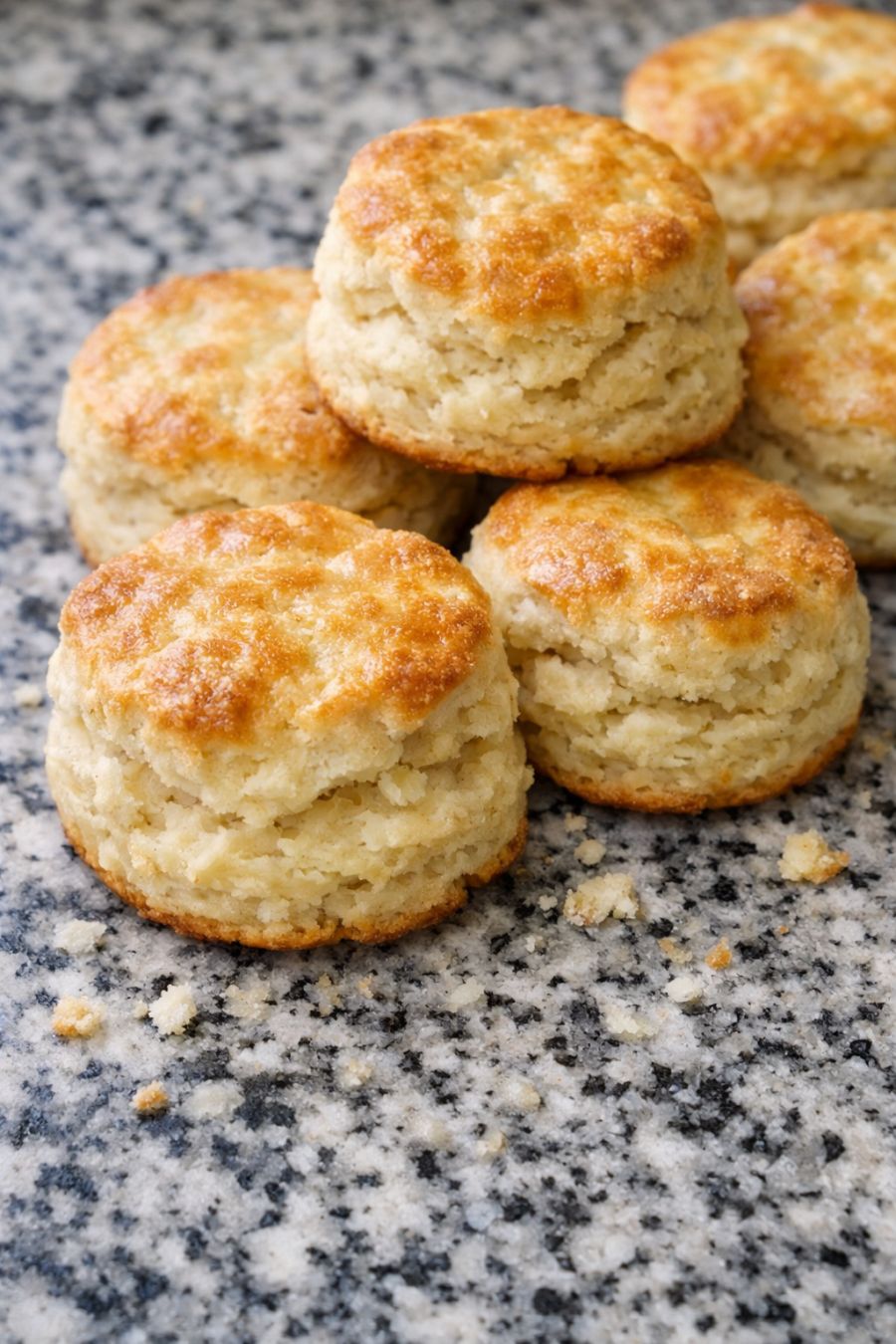
These southern 3-ingredient buttermilk biscuits are what my late husband used to call “Sunday morning fluff.” They’re the kind of biscuit that showed up on every church potluck table and every farmhouse counter from here clear up through the Midwest—tender, high, and soft inside with a light golden top. With just self-rising flour, cold butter, and real buttermilk, they taste just like the ones his mama made in her small country kitchen, no fuss and no fancy tricks. This is the recipe you reach for when you want that old-fashioned comfort without a sink full of dishes or a long list of ingredients.
Serve these biscuits warm, split open on a speckled gray granite counter or your own kitchen table, with soft butter, homemade jam, or a drizzle of honey. They’re perfect alongside scrambled eggs and crispy bacon, a skillet of sausage gravy, or a pot of hearty beef stew. In the afternoon, they make a lovely treat with coffee or hot tea, and any leftovers can cradle a slice of country ham or cold fried chicken for a simple little sandwich.
Southern 3-Ingredient Buttermilk Biscuits
Servings: 8–10 biscuits
Ingredients
2 cups self-rising flour, plus extra for dusting
1/2 cup (1 stick) cold unsalted butter, cut into small cubes
3/4 to 1 cup cold buttermilk
Directions
Preheat your oven to 450°F (230°C). Line a baking sheet with parchment paper or lightly grease it. If you have a speckled gray granite counter, clear a spot and wipe it clean for rolling and cutting; otherwise, any clean, cool surface will do.
In a large mixing bowl, add the self-rising flour. Scatter the cold, cubed butter over the flour. Using your fingertips or a pastry cutter, work the butter into the flour until the mixture looks like coarse crumbs with some pea-sized bits of butter still visible. Those little butter pieces are what give you flaky layers.
Make a well in the center of the flour mixture and pour in 3/4 cup of the cold buttermilk. Gently stir with a fork just until the dough comes together and there are no big dry patches. If the dough is still too dry and crumbly, add buttermilk a tablespoon at a time until it forms a soft, slightly shaggy dough. Do not overmix or your biscuits will be tough.
Lightly flour your speckled gray granite counter (or work surface). Turn the dough out onto the floured surface and sprinkle a bit of flour on top of the dough. With floured hands, gently pat the dough into a rectangle about 1/2 to 3/4 inch thick.
To build flaky layers like the old-timers did without thinking twice, fold the dough in half over itself, then gently pat it back out into a rectangle. Repeat this folding and patting 2 more times, dusting lightly with flour if needed to keep it from sticking. Keep a light hand; you’re coaxing it, not wrestling it.
Pat the dough out one last time to about 3/4 inch thickness. Dip a round biscuit cutter or the rim of a small drinking glass in flour, then press straight down into the dough without twisting. Place each cut biscuit onto the prepared baking sheet, with the sides just barely touching for softer edges, or spaced slightly apart for more crusty sides.
Gather the scraps, gently press them back together, and cut more biscuits, being careful not to overwork the dough. The last one might look a little rustic, but it will still taste just like mama’s.
Bake on the middle rack of the oven for 10–14 minutes, or until the tops are lightly golden and the biscuits are risen and fluffy. Every oven has its own personality, so start checking at 10 minutes.
Remove the biscuits from the oven and, if you like, brush the tops lightly with a bit of extra buttermilk or a dab of melted butter (this is optional and doesn’t count as an ingredient in the dough itself). Let them sit on the pan for 2–3 minutes, then serve warm right from the kitchen counter.
Variations & Tips
If you don’t keep self-rising flour on hand, you can mimic it by using all-purpose flour and adding 3 teaspoons baking powder and 1/2 teaspoon fine salt for every 2 cups of flour, though that technically adds extra ingredients and strays from the strict 3-ingredient spirit. For a slightly richer biscuit, grate the cold butter on the large holes of a box grater directly into the flour instead of cubing it; this makes it easier to work in without melting. If your kitchen runs warm, chill the flour and bowl for 10–15 minutes before starting so the butter stays cold and the biscuits puff higher. To give them a more rustic, farmhouse look like the pans I remember cooling on my mother’s old countertop, skip the cutter and simply pat the dough into a thick circle and cut it into wedges. You can also nestle the biscuits close together in a cast-iron skillet for soft, pull-apart sides and a crisp, golden bottom. For a touch of sweetness reminiscent of church basement suppers, stir 1–2 teaspoons of sugar into the flour before adding the butter, but keep in mind that even without sugar, the real charm of these biscuits is their simple, savory, buttery flavor that lets the buttermilk shine.



.jpg)


0 commentaires:
Enregistrer un commentaire